top of page


The Standard
The Four Pillars
Road pricing is more than the sum of its parts. It is a multidisciplinary mix of art and science sitting at the intersection of policy, finance, people and cutting-edge tech. Until now, this knowledge was fragmented. IRPP synthesizes these disparate skills into a Road Pricing Professional Body of Knowledge (RPP-BoK) curated by the SMEAG. The RPP-BoK provides the "Common Language" that allows a road pricing professional Civil Engineer in New York to speak the same technical tongue as a professional data Scientist in california or policy analyst in Florida. To earn the RPP credential, one must demonstrate mastery across four domains, 'pillars' that represent the holistic expertise required to design, implement and operate a road pricing system.
1. Policy & Governance
-
The Goal: Understanding the "Why" behind the system.
-
Core Competencies: Legislative frameworks, public equity and social impact, stakeholder engagement, and the transition from traditional fuel taxes to user-fee models.
2. Financial & Revenue Management
-
The Goal: Ensuring the fiscal integrity of the infrastructure.
-
Core Competencies: Revenue forecasting, toll rate setting, back-office financial reconciliation, leakage prevention, and long-term debt service/P3 (Public-Private Partnership) structures.
3. Technology & Operations
-
The Goal: Managing the "How" of the system.
-
Core Competencies: ETC roadside systems, AVI/transponder protocols, Back Office Systems (CBOS/OBOS), plate-based imaging, emerging AVI (satellite-based, C-V2X, LIDAR, etc.) and toll point configuration.
4. Planning & System Design
-
The Goal: Architecting the future.
-
Core Competencies: Traffic demand modeling, environmental impact assessments, network integration, and designing for scalability (AI/ML/Big Data integration).
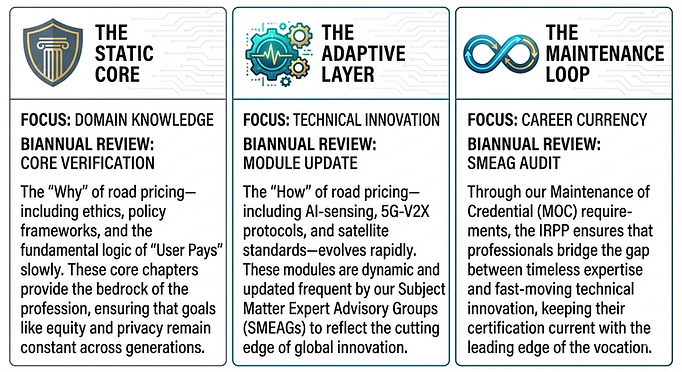
A Living Standard: the RPP-BoK Methodology
The architecture separates timeless principles from evolving tech to ensure the credential stays valid.

bottom of page